Stationery a Pivoting Device That Draws Circles

A axle compass and a regular compass

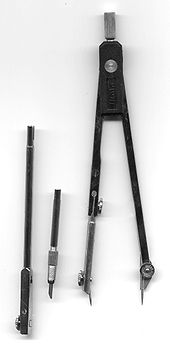
A compass with an extension accessory for larger circles

A bow compass capable of drawing the smallest possible circles
A compass, more than accurately known as a pair of compasses, is a technical drawing instrument that tin can be used for inscribing circles or arcs. As dividers, it tin can also exist used as a tool to step out distances, in particular, on maps. Compasses can be used for mathematics, drafting, navigation and other purposes.
Prior to computerization, compasses and other tools for manual drafting were often packaged as a set[1] with interchangeable parts. By the mid-twentieth century, circle templates supplemented the use of compasses.[ citation needed ] Today those facilities are more often provided by computer-aided design programs, so the physical tools serve mainly a didactic purpose in pedagogy geometry, technical cartoon, etc.
Construction and parts [edit]
Compasses are usually made of metallic or plastic, and consist of two "legs" connected by a hinge which can exist adjusted to permit irresolute of the radius of the circumvolve drawn. Typically i leg has a spike at its end for anchoring, and the other leg holds a drawing tool, such every bit a pencil, a short length of but pencil lead or sometimes a pen.
Handle [edit]
The handle, a small knurled rod above the hinge, is normally virtually half an inch long. Users tin can grip it between their pointer finger and pollex.
Legs [edit]
There are 2 types of leg in a pair of compasses: the straight or the steady leg and the adjustable one. Each has a separate purpose; the steady leg serves as the ground or support for the needle betoken, while the adjustable leg tin be altered in order to draw different sizes of circles.
Hinge [edit]
The screw through the swivel holds the 2 legs in position. The hinge can be adapted, depending on desired stiffness; the tighter the hinge-screw, the more accurate the compass's performance. The better quality compass, made of plated metal, is able to be finely adapted via a pocket-sized, serrated wheel usually set between the legs (see the "using a compass" animation shown to a higher place) and it has a (dangerously powerful) spring encompassing the hinge. This sort of compass is often known as a "pair of Jump-Bow Compasses".
Needle point [edit]
The needle indicate is located on the steady leg, and serves as the center indicate of the circumvolve that is about to exist drawn.
Pencil pb [edit]
The pencil lead draws the circle on a detail paper or textile. Alternatively, an ink bill or zipper with a technical pen may exist used. The better quality compass, made of metal, has its piece of pencil lead peculiarly sharpened to a "chisel edge" shape, rather than to a betoken.
Adjusting nut [edit]
This holds the pencil lead or pen in place.
Uses [edit]
Circles can be fabricated by pushing one leg of the compasses into the paper with the fasten, putting the pencil on the newspaper, and moving the pencil around while keeping the legs at the same angle. Some people who find this action difficult often hold the compasses however and move the paper round instead. The radius of the intended circumvolve can exist inverse by adjusting the initial angle betwixt the two legs.
Distances can be measured on a map using compasses with two spikes, also called a dividing compass (or just "dividers"). The hinge is set in such a way that the distance between the spikes on the map represents a certain altitude in reality, and by measuring how many times the compasses fit between two points on the map the distance between those points can be calculated.
Compasses and straightedge [edit]
Compasses-and-straightedge constructions are used to illustrate principles of plane geometry. Although a real pair of compasses is used to draft visible illustrations, the ideal compass used in proofs is an abstract creator of perfect circles. The virtually rigorous definition of this abstract tool is the "collapsing compass"; having fatigued a circle from a given betoken with a given radius, it disappears; it cannot simply be moved to another point and used to draw another circle of equal radius (unlike a real pair of compasses). Euclid showed in his second proposition (Book I of the Elements) that such a collapsing compass could be used to transfer a distance, proving that a collapsing compass could do anything a existent compass tin do.
Variants [edit]
A beam compass is an instrument, with a wooden or contumely beam and sliding sockets, cursors or trammels, for drawing and dividing circles larger than those made past a regular pair of compasses.[2]
Scribe-compasses [3] is an instrument used by carpenters and other tradesmen. Some compasses can be used to draw circles, bisect angles and, in this example, to trace a line. Information technology is the compass in the most simple form. Both branches are crimped metal. 1 branch has a pencil sleeve while the other co-operative is crimped with a fine indicate protruding from the end. A wing nut on the swivel serves two purposes: kickoff it tightens the pencil and secondly it locks in the desired distance when the fly nut is turned clockwise.
Loose leg fly dividers [4] are fabricated of all forged steel. The pencil holder, thumb screws, brass pivot and branches are all well built. They are used for scribing circles and stepping off repetitive measurements[five] with some accuracy.
A proportional compass, besides known every bit a armed forces compass or sector, was an instrument used for adding from the end of the sixteenth century until the nineteenth century. It consists of two rulers of equal length joined by a hinge. Dissimilar types of scales are inscribed on the rulers that allow for mathematical adding.
A reduction compass is used to reduce or overstate patterns while conserving angles.


As a symbol [edit]

A computer fatigued compass, used to symbolize precise designing of applications.
A pair of compasses is often used every bit a symbol of precision and discernment. As such it finds a place in logos and symbols such every bit the Freemasons' Square and Compasses and in diverse figurer icons. English poet John Donne used the compass as a conceit in "A Valediction: Forbidding Mourning" (1611).
-

Compass for tracing a line.
-

Flat branch, pivot wing nut, pencil sleeve branch of the scribe-compass.
-

six inch (15 cm) dividers fabricated from forged steel.
-

One type of sector.
-
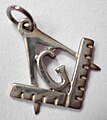
The compass is a Masonic symbol that appears on jewellery such every bit this pendant.
Encounter also [edit]
- Dividers
- Circle
- Geometrography
- Masonic Square and Compasses
- Technical drawing tools
References [edit]
- ^ a current vendor'southward product
- ^
 This commodity incorporates text from a publication now in the public domain:Chambers, Ephraim, ed. (1728). "Beam-Compasses". Cyclopædia, or an Universal Dictionary of Arts and Sciences (1st ed.). James and John Knapton, et al.
 - ^ Fine Woodworking, Build a Fireplace Mantel, Mario Rodriquez, pgs. 73, 75, The Taunton Press, No. 184, June 2006
- ^ The Carpenter'southward Manifesto, Jeffrey Ehrlich & Marc Mannheimer, Holt, Rhinehart & Winston, pg. 64, 1977
- ^ Fine Woodworking, Laying out dovetails, Chris Gochnour, pg. 31, The Taunton Press, No. 190, April 2007
External links [edit]
- Beam or trammel compass (variant form)
Source: https://en.wikipedia.org/wiki/Compass_%28drawing_tool%29
0 Response to "Stationery a Pivoting Device That Draws Circles"
Postar um comentário