Can a 22 Year Old Run for House of Representatives
The Right to Run
If you can vote, you should be able to run for public office—any office.
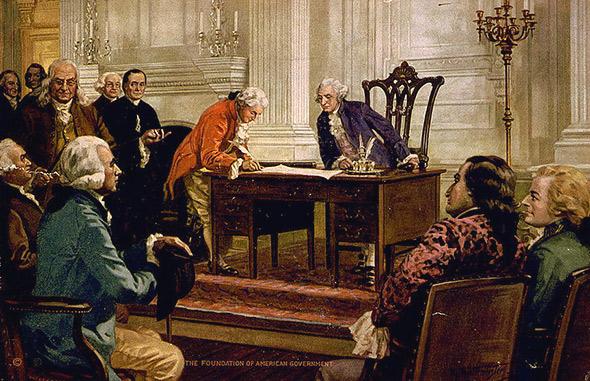
Image by Henry Hintermeister/courtesy Library of Congress
In Jan, land Sen. Linda Lopez of Arizona retired after xiii years in the legislature. Before announcing her retirement, Lopez looked for a candidate to endorse to fill her vacancy. She before long settled on Daniel Hernandez, Jr., a friend and a board fellow member of Tuscon's Sunnyside Unified Schoolhouse Commune. He agreed and began gathering support to run for office. A win seemed likely.
At that place was just i problem. Hernandez was 24. Arizona constabulary requires legislators to be at least 25 years old. Only Hernandez initially hoped he could run because he would turn 25 simply 13 days afterwards beingness sworn in. Information technology wouldn't have been unprecedented. Young federal and land legislators-to-be have plant means to piece of work effectually age of candidacy laws for almost as long as the laws take existed. Back in 1806, antebellum statesman Henry Clay was appointed to the U.South. Senate at the historic period of 29 and reached the Senate's historic period of eligibility, thirty, more three months later on existence sworn in. No one seemed to mind.
Hernandez wasn't so lucky. Every bit he found out, Arizona state police requires candidates to sign an affirmation proving that they will be eligible for the office they seek on Election Solar day, disallowment him from running altogether. The constabulary was clear: 24-year-one-time Hernandez was unqualified to serve in the state Senate this year. But a 25-year-old Hernandez would accept been fine.
It didn't thing that Hernandez had already worked on educational activity legislation as a lobbyist and managing director of the Arizona Students' Clan. His service on the city of Tucson's GLBT commission, a body that advises the metropolis's mayor and city council on queer rights, was similarly irrelevant. His management of state Sen. Steve Farley'due south re-election campaign, his work every bit the Southern Arizona Managing director of erstwhile Surgeon General Richard Carmona's Senate campaign, and his part as a Latino Outreach Coordinator for the Arizona Democratic Party all counted for null. And the job he is best known for, in the eyes of the law, was just as meaningless.
In January 2011, Hernandez began working as a staffer to Arizona Rep. Gabrielle Giffords.
Information technology was Hernandez who, only five days afterwards starting piece of work, delivered the initial care that saved Giffords' life after Jared Lee Loughner's assassination try. In a speech at a nationally televised vigil for the incident's victims, Hernandez claimed he wasn't a hero. President Obama disagreed and said and so.
Simply the historic period requirements of the Arizona constitution don't bend for heroes. According to the law, Daniel Hernandez is not an individual with a body of accomplishment. He is a 24-year-old. And 24-year-olds, the law presumes, are too immature to serve in the Arizona land house.

Photo by David Becker/Getty Images
"I have more experience with legislation than a lot of people running who are in their 40s," he told me. "Information technology'south been a really kind of interesting experience for me to listen to the argument that young people don't accept experience when I've been doing this for years."
* * *
Young people like Hernandez are rare, but non terribly so. Qualified candidates have their efforts thwarted by age of candidacy laws in elections across the land every year. Each time, people like Hernandez are told to wait their turn.
Here is a seldom discussed truth most our democracy: The citizenship enjoyed past American adults under the age of 35 is a 2nd-course citizenship. We gain the right to participate fully in American democracy on our 35th birthdays, and not a twenty-four hour period before. For on that day, provided all other requirements are met, nosotros become constitutionally eligible to run for nearly all federal, state, and local offices, including the presidency. The fact that very few of the states will ever exercise the right to run for any office is irrelevant to the milestone's significance. The consequence of the nation'southward age of candidacy laws is that one-third of American adults—the more than 74 million people betwixt xviii to 35—don't enjoy full political rights: If they're citizens, they accept the right to vote without necessarily having the correct to be voted for. This is wrong.
The right of Americans 18 and older to vote was guaranteed by the 26th Amendment, which, later on being speedily ratified in 1971, lowered the voting age from 21 to 18. That amendment came into beingness afterward years of protest by youths who could non vote for or confronting the wars they were forced to fight. Those protests were nearly competence as much as they were about unfairness. How was it possible that an 18 twelvemonth old could be mature enough to kill, but not mature enough to bandage a election? Today, the very same kind of question can be asked near the correct to run for office. As Pomona Higher professor John Seery writes in his book about the Constitution's age requirements, Too Immature To Run, the historic period of 18, as the age of bulk in most of the country, grants one the right to accept on a whole host of consequential responsibilities.
"In our country, eighteen- to thirty-four-year-olds tin buy cigarettes, donate organs, play the lottery, drive cars, fly airplanes, shoot guns, start businesses, own homes, sign contracts, accept consensual sexual activity, get married, become divorced, have children, have abortions, join the military, serve as jurors, and be tried in court equally full adults," he writes. "But for some reason they are still branded, as an unabridged group, as somehow too young and besides inexperienced to run for one or more than categories of elected federal function."

Photo past Ann Hermes/The Christian Scientific discipline Monitor via Getty Images
Seery believes, given all the other rights and responsibilities one takes on by the time they've turned 18, that 18-yr-olds should also be granted the correct to run for federal office by a constitutional amendment. But one could go even further. The 26th Amendment granted 18-yr-olds the right to vote in both federal and land elections. A new amendment inspired past the 26thursday could similarly grant all adults xviii and older the correct to run in all elections federal, country, and local—an expansion of rights that would have helped Daniel Hernandez equally much equally it volition a 24-twelvemonth-old hoping to get into Congress.
* * *
Anyone who delves into the origins of the Constitution's historic period requirements with the expectation that the Founding Fathers idea long and difficult most them will be disappointed. The Constitution'south requirements represent yet another instance in which the Founding Fathers traded wisdom for simple prejudice. Age restrictions were never given the lengthy considerations given to belongings qualifications and restrictions based on citizenship—information technology was enough for men like John Adams to simply assume that civic competence grew naturally with age. In 1776, Adams delivered a manus-waving defense of Massachusetts' voting age in a letter to James Sullivan, who would afterwards become the country's governor. "What Reason Should there exist, for excluding a Man of 20 years, Eleven Months and twenty-seven days quondam, from a Vote when you admit one, who is twenty one?" he wrote. "The Reason is, you must ready upon Some Menstruation in Life, when the Agreement and Will of Men in full general is fit to be trusted by the Public." Translation: "You've gotta pick some age, right?" One tin can almost picture him shrugging every bit he wrote those words.
Had there been a near universal age of majority as in that location is at present, Adams and the rest might accept chosen it as the starting point for candidacy rights. Simply in the absence of one, near of the colonies came up with their own arbitrary age requirements for candidacy.
The drafters of the federal Constitution, after most no contend on the subject area, would practise the same at the Ramble Convention of 1787. The only commutation recorded in James Madison's notes on the convention about any of the age requirements in the Constitution—for the House, Senate, or presidency—took place on the 25th day of proceedings between Virginia delegate George Mason and Pennsylvania consul James Wilson. It was Mason—a statesman Thomas Jefferson called the "wisest human being of his generation" for his work drafting Virginia's highly influential 1776 Constitution and Annunciation of Rights—who was responsible for the requirement that members of the Business firm of Representatives be at to the lowest degree 25. His argument was unproblematic: He had been an idiot at 21 and figured that nigh 21-year-olds were almost the same.

Supreme Courtroom Justice James Wilson.
Epitome courtesy Creative Commons
"He would if interrogated be obliged to declare that his political opinions at the age of 21 were as well crude and erroneous to merit an influence on public measures," James Madison wrote of Bricklayer. "It had been said that Congress had proved a good school for our immature men. It might be so for whatsoever thing he knew merely if information technology were, he chose that they should bear the expense of their own education."
James Wilson, a lawyer who would after become one of the get-go Supreme Courtroom justices, was the alone dissenter. He argued, Madison writes, that age restrictions in full general, "tended to damp the efforts of genius" and that old age restrictions made merely as much sense every bit restrictions on youth. He also cited the competence of then British Prime Minister William Pitt the Younger—the English had been willing to let a 24-yr-old lead an empire.
Nevertheless, Mason's view carried the day. The motion to set the House candidacy age to 25 passed 7–iii. The ages proposed for the Senate (30) and the presidency (35) were later approved unanimously without discussion.

George Bricklayer delegate from Virginia.
Prototype courtesy of Creative Commons
Reading Mason's thoughts and the vote counts, you might assume that the convention was comprised solely of elder statesmen. In fact, 12 delegates were under the age of 35 and four of them—Due north Carolina'south Richard Dobbs Spraight, Maryland's John Francis Mercer, New Jersey's Jonathan Dayton, and South Carolina's Charles Pinckney—were in their 20s when the convention began. All iv, the finished Constitution would suggest, would accept been as well young to draft and contend ordinary legislation in the new Senate. Yet all four were, incredibly, considered just seasoned enough to participate in the drafting of the Constitution itself.
Since then, nearly all state constitutions have included age qualifications of their own. Some hew closely to those outlined in the federal Constitution. Many exercise not. Consequently, the right of a young person to run for office in the U.s.a. is determined by a nonsensical patchwork of statutes that is plain indefensible for its arbitrariness, fifty-fifty if 1 genuinely believes that young people, by and large, can't be trusted with elected office.
A 21-year-old can govern Southward Dakota, for example, but tin't stand for districts with a few thou voters in Arizona or Colorado. North Dakota, like many states, tin can't have a governor under the age of 30, while Oklahoma, for reasons that are either lost to history or nonexistent, expects its governors to be at least 31. Texas is fine with 26-year-old state senators. The state of Delaware forbids state senators under the age of 27.
The picture gets fifty-fifty more distorted when mayors are thrown into the mix. Under current law, an 18-year-quondam is legally qualified to govern millions of people in New York Urban center, Los Angeles, and Chicago. But 18-yr-olds are barred from beingness elected to Congress at all—information technology would exist too risky, the Constitution presupposes, to permit someone so immature represent, say, Wyoming, a state with a population of virtually 500,000.
Some might argue that the differences are justified by the notion that states and localities should be laboratories of democracy, with the ability to ready many of their own rules and regulations. But it's a perversion of that notion to propose that laboratories of republic should be given the freedom to exist so plainly antidemocratic. In this instance, what is and is not democratic isn't dictated by the federal Constitution, which is also in the incorrect. It is dictated by common sense—the right to run for office is something fundamental, something that shouldn't vary from place to identify for taxpaying, law-abiding young citizens who are otherwise equal nether the law. The current patchwork of laws suggests that there are innate differences between being 21 in South Dakota and 21 in Arizona that make 1 qualified to concord role in one place and not the other. Even George Bricklayer did not believe this.
* * *
The ane affair these barriers to public service have in mutual, of course, is their foundation in clichés about youth that seem less true every year. Of course, many young adults are young and unreliable. But others are making critical advancements in medicine. They are thriving on Wall Street. They are tending to the underprivileged at habitation and abroad. They have always excelled in the arts. They are today some of our nearly impressive inventors, physicists, lawyers, media executives, social scientists, and ceremonious servants. And they have been, for decades now, amidst our most transformative businesspeople—bankroll and producing technologies that have contradistinct everyday life. Young people today found multibillion-dollar corporations and successful NGOs. As young staffers, researchers, and yes, interns, they do much of the analysis that our lawmakers depend on. Yet we've kept in place laws that suggest they lack the intelligence, dedication, and maturity to legislate and govern—at least until they reach a random set up of arbitrarily predetermined ages.
The fact that these preconceptions have been codified and stubbornly retained says something near how securely some implicitly fear the idea of young people exercising full political rights. The drafters of these constitutions believed that voters could be trusted to make judgments about strange policy, taxes, and nearly all of the other qualifications candidates present about themselves. But they could not, evidently, be trusted to assess the competence of young candidates on a case-by-instance basis—for that would risk the chance of some ne'er-do-wells actually existence elected. Young ones, anyways. The correct of ne'er-do-wells older than 35 to run for president is constitutionally protected.
In a few places though, very young candidates are allowed to run. And they oftentimes win.
Vermont is one of a scattering of states that permit adults to run for any function they choose. When Kesha Ram was elected to the Vermont legislature in 2009, she became the youngest state representative in the country at the age of 22. She and Hernandez are both members of the Young Elected Officials network, a grouping that helps young progressive politicians navigate the electoral mural. Surprisingly she says, she had piffling problem winning the back up of voters.
"I went to knock on doors with this fear that people wouldn't have me seriously or would really question my age and I establish that the opposite was true," she says. "Most people I talked to were thrilled that a immature person was trying to bear the torch and wanted to get involved in this way. And and so I really institute by the finish of the campaign that it was an incredible do good to my race rather than a detriment."
Cutting through preconceptions most youth in the legislature has occasionally been more of a challenge. Early in her first term, Ram participated in a hearing on youth and alcohol policy. "One of the legislators requested a whole session on brain development and how people don't really take their brains developed until they're 25 or older, and here I was 22 in the committee. And I said, in a big hearing, 'Well I'm only 22, then have my question as a legislator with a grain of common salt.' "
Similar Hernandez and many twentysomethings, Ram's accomplishments fly in the confront of what developmental psychologists might accept to say nigh young people in the amass. She was heavily involved in environmental activism as a high schoolhouse pupil in her hometown of Los Angeles and debuted a documentary well-nigh globalization at the World Social Forum in Republic of india. She was awarded the Morris Thou. Udall Scholarship for her environmental work and was a finalist for the Rhodes Scholarship. Every bit a legislator, she's sponsored legislation on homelessness, higher education, housing regulations, and domestic violence—an issue she took on every bit the legal director of Chittenden County Vermont'south Women Helping Battered Women, a nonprofit that provides services to victims of domestic abuse.
Or consider John Tyler Hammons, who in 2008 was elected mayor of Muskogee, Oklahoma, at the age of xix. Hammons never thought he'd get elected. "I probably didn't think I was going to win because who's going to vote for a nineteen-yr-old," he says. But he did win—twice—and returned to the Academy of Oklahoma to study law subsequently his 2d term. During his time in role, he pushed for reforms to the city'due south lease, entrada finance regulations, and increases in infrastructure spending. He left office, the Muskogee Phoenix opined, as perhaps the city's nigh popular mayor ever.
"I think my openness to ideas won me a lot of support in city hall very fast," he says. "I think that they were honestly initially very skeptical, but at the end of my tenure, by the fourth dimension I left, there were people in urban center hall who trusted my judgment over people several times older than me, because I'd taken the effort to acquire."
People like Ram and Hammons offer skilful examples of the kind of public service immature people can engage in if they're allowed to. The idea that either 1 of them might have been barred from running because of their historic period should concern u.s.a..
* * *
To be sure, in that location are broader reasons to back an terminate to age restrictions. At that place are legions of youth activists and earnest young people beyond the nation who will tell yous that boosting immature developed candidacy would unleash an unprecedented moving ridge of youth activism, make races more competitive, and lead to new activity on problems such as pupil loans and youth unemployment. And they may be right. Only such hopes aren't the central justifications for change. Even if progress on youth issues continues to stall and fifty-fifty if young candidates are beaten out by older and more than established politicians—as they certainly will be most of the time—establishing a universal correct to stand up for public office is worthwhile on its own claim.
"It'southward sort of similar in 1919, when the franchise was extended to women for 1920, if people had said, 'Well all of this hinges on whether women volition actually outset voting in big numbers next year,' " Seery says. "The principle sort of trumps the practice."
Whether it yields policy changes and boosts participation or not, a constitutional subpoena doing away with age of candidacy restrictions will simply extend rights to a politically underprivileged constituency just as the 15thursday and 19th Amendments did for women and blacks—a worthy objective in and of itself.
Afterwards every election bike nosotros accept stock of gains for women, blacks, Latinos, the LGBTQ customs, and others in Congress. Over time, we promise, the body will come to look more like the United States and less like a country club—a truly representative body. Lost in these assessments is the fact that information technology is virtually impossible for young adults to ever achieve a share of Congress proportionate to their share of the population. Simply 1 pct of the current Congress is nether the age of 35 despite the fact that, once again, nearly one-third of adult Americans are.
Of form, information technology isn't a given that constituencies are necessarily amend represented by politicians from their ranks—a white politico can champion policies that help black Americans, a male politician can promote policies that help women. But information technology should be inside voters' rights to select candidates like them if they believe shared experience really does make a difference. A black voter who thinks a blackness politico would be better attuned to the issues affecting him can vote for a blackness politician. A woman can vote for a woman. But a twenty-yr-old cannot, by law, vote to transport another 20-twelvemonth-old to Congress. Because the 26thursday Amendment established an implicit separation between the right to cast a ballot and the right to run, he is required to vote for someone at a dissimilar station in life than himself.
The well-nigh critical argument presented against age restrictions at the convention was an argument against precisely this kind of separation—one couched in the thought that the right to run and the correct to vote represent halves of a cohesive whole. Wilson, Madison writes, was "confronting abridging the rights of ballot in whatsoever shape. Information technology was the same affair whether this were done by disqualifying the objects of option, or the persons chusing."
He was right. To cleave apart the right to choose and the correct to be called is to cleave apart commonwealth itself. Historic period of candidacy laws should, intuitively, disharmonism with notions almost representation and democratic fairness that nosotros all share. Just ours is a society that, for years, sent young people to die abroad without granting them a say in the matter at abode. We are all too willing to subvert the rights of youth when we can go away with it. The 26th Amendment was an effort to confront this—a partial assertion that one's trust or distrust of young adults should be irrelevant to his or her ability to possess the rights of other citizens. An amendment extending the full correct of candidacy to all young adults should logically follow. Our democracy will be amend for it.
Source: https://slate.com/news-and-politics/2014/10/age-of-candidacy-laws-should-be-abolished-why-18-year-olds-should-be-able-to-run-for-public-office.html
0 Response to "Can a 22 Year Old Run for House of Representatives"
Postar um comentário